Wednesday, November 28, 2018

ABSTRACT

The researcher was interested in undertaking the present study which dealt with assessing descriptive text writing ability of the tenth grade students of SMKN 2 Sukawati in academic year 2017/2018 through guided question and answer. The present study was intended to figure out the achievement of descriptive text writing ability of the tenth grade students of SMKN 2 Sukawati in academic year 2017/2018 which was assessed by administering guided question and answer test. the present study used ex post facto as the research design. The samples were the tenth grade students which consisted of 34 students. They were determined by means of cluster sampling. the data which were needed for the present study were collected through administering guided question and answer test as the research instrument. The obtained data were analyzed by using norm-reference measure of five standard values. The results showed that there were 67.65% or 23 samples (it includes excellent, good, and insufficient) of the samples who were successful and 32.35% or 11 samples (it includes text which was assessed by administering guided question and answer. It means that the use of guided question and answer was successful  in assessing the students' descriptive text writing ability.

Keywords: assessing, descriptive text writing ability, and guided question and answer.

Thursday, November 15, 2018

ASSIVE VOICE

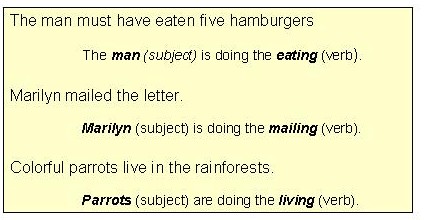
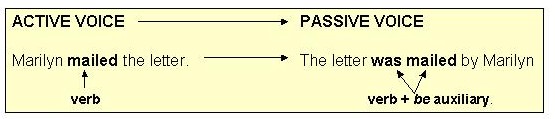
In most English sentences with an action verb, the subject performs the action denoted by the verb.
    These examples show that the subject is  doing the verb's action.
            
Because the subject does or "acts upon" the verb in such sentences, the sentences are said to be in the active voice.

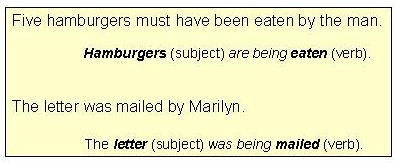
One can change the normal word order of many active sentences (those with a direct object) so that the subject is no longer active, but is, instead, being acted upon by the verb - or passive.
    Note in these examples how the subject-verb relationship has changed.
            
Because the subject is being "acted upon" (or is passive), such sentences are said to be in the passive voice.
NOTE:   Colorful parrots live in the rainforests cannot be changed to passive voice because the sentence does not have a direct object.
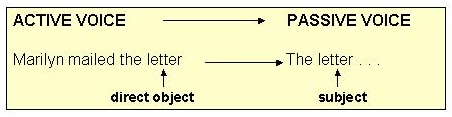
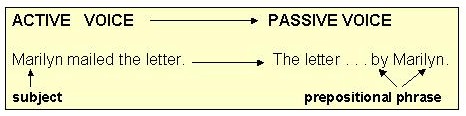
To change a sentence from active to passive voice, do the following:
    1.  Move  the active sentence's direct object into the sentence's subject  slot
             
    2. Place the active sentence's subject into a  phrase beginning with the preposition  by
              
    3.  Add a form of the auxiliary verb be to the main verb and change the  main verb's form
              
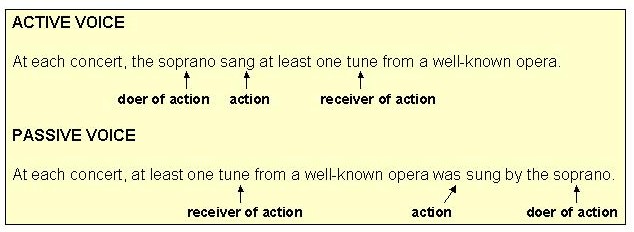
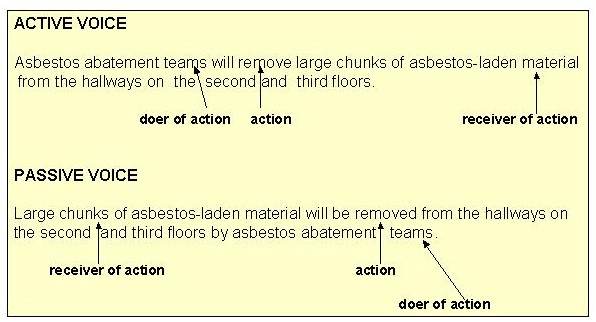
Because passive voice sentences necessarily add words and change the normal doer-action-receiver of action direction, they may make the reader work harder to understand the intended meaning.
As the examples below illustrate, a sentence in  active voice  flows more smoothly and is easier to understand than the same sentence in  passive voice.
             
            
It is generally preferable to use the ACTIVE voice.

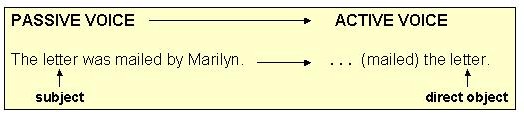
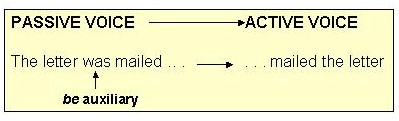
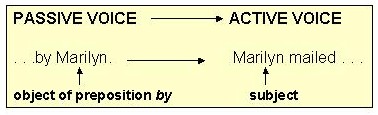
To change a passive voice sentence into an active voice sentence, simply reverse the steps shown above.
    1.  Move  the passive sentence's subject into the active  sentence's  direct object slot
             
    2.  Remove  the auxiliary verb be from the main verb and change main verb's form if needed
            
    3. Place the passive sentence's object of the preposition by into the subject slot.
           
Because it is more direct, most writers prefer to use the active voice whenever possible.
The passive voice may be a better choice, however, when
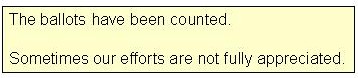
  • the doer of the action is unknown, unwanted, or unneeded in the sentence
             Examples
             
  • the writer wishes to emphasize the action of the sentence rather than the doer of the action
            Examples